
From Public Opinion to Practitioner Truth: A Practice Based AR Journey


ARTIVIST : creative by any means necessary!
TOIAGENCY Limited - NZBN:9429050721276
Auckland, Aotearoa, New Zealand
+64 22 378 3253 | www.artivist.co.nz
Wednesday, 22 April 2026
RE : Presentation Script
Opening
“Tēnā koutou katoa. This presentation outlines how my research shifted from broad public opinion towards practice-based insight, and how that shift revealed a clearer framework for designing believable AR.”
Slide 1 — Title
“Ngā mihi, my name is Joffre Rae Kopu, and this presentation is titled From Public Opinion to Practitioner Truth: A Practice-Based AR Journey.
This research sits within my Master of Technological Futures and asks a central question:
how can practice-based development reveal the design conditions that sustain or disrupt suspension of disbelief in augmented reality? The work is grounded in AR+IQ and AR+artist™ as both creative platforms and research instruments. Rather than treating AR as something I observe from the outside, this project treats making, deploying, observing and reflecting as the research itself.”
Slide 2 — The starting point: a wrong assumption
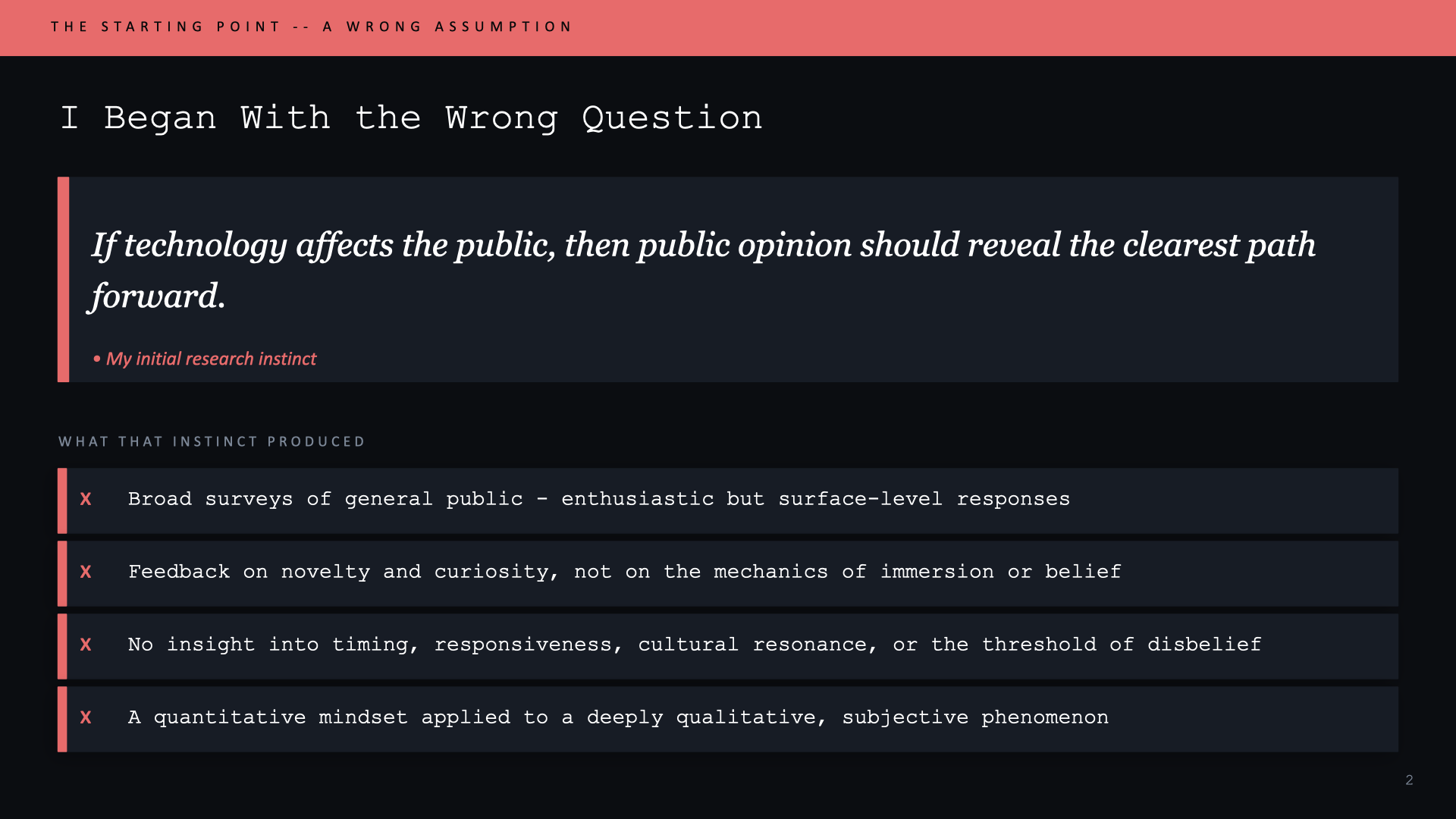
“I began with the wrong question. My initial assumption was that if technology affects the public, then public opinion would reveal the clearest path forward. That instinct led me towards broad public surveying and a more conventional research model.
But what that produced was mostly surface-level response: interest, novelty, curiosity, confusion. It did not tell me much about timing, responsiveness, cultural resonance, or the threshold where disbelief holds or collapses. In hindsight, I was applying a quantitative instinct to a deeply qualitative and subjective phenomenon.”
Slide 3 — The methodological pivot
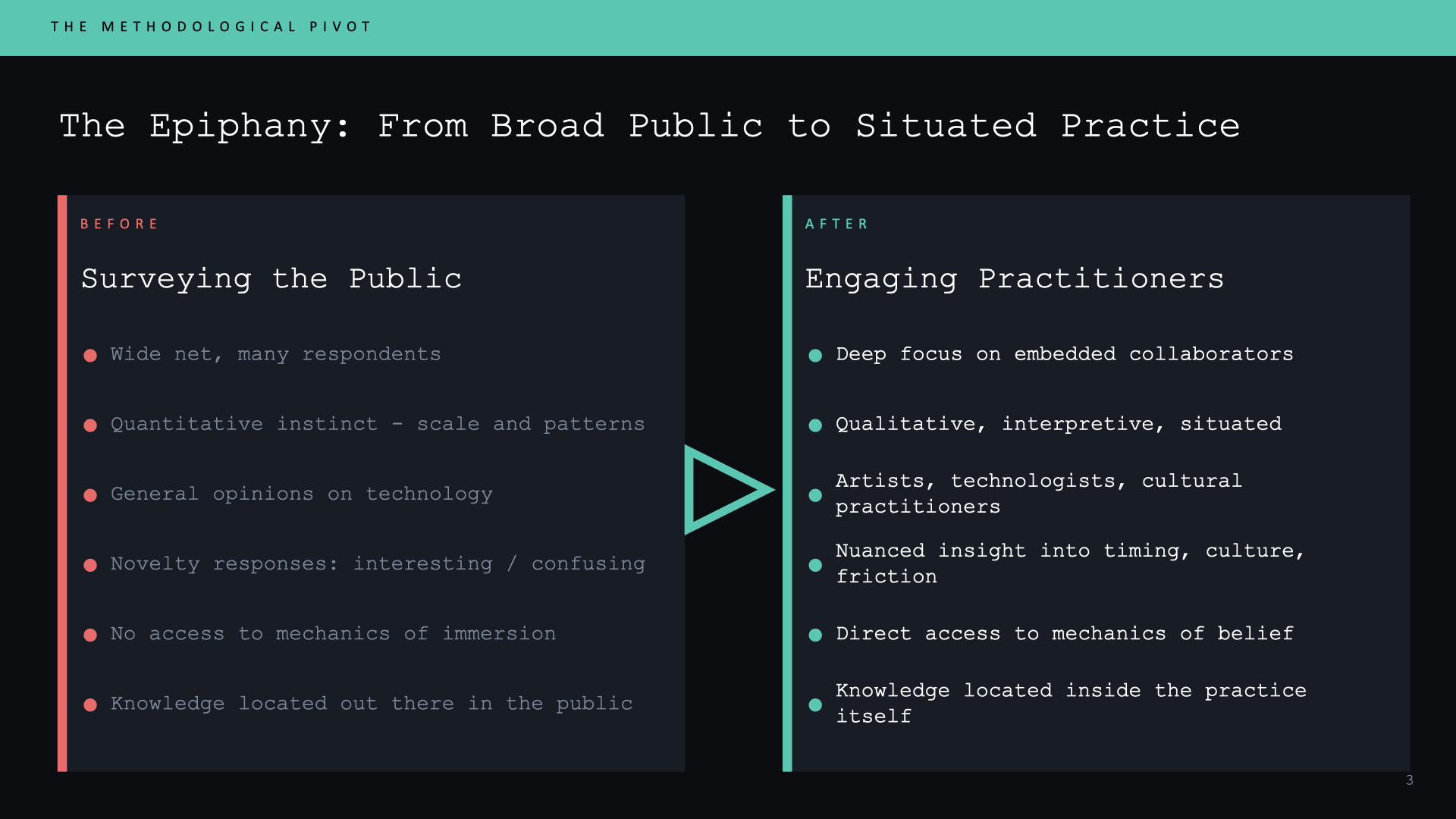
“The pivotal shift in this research was methodological. I moved from surveying a broad public to engaging embedded practitioners.
Before this shift, I was gathering general opinions on technology. After it, I was working with artists, technologists and cultural practitioners whose insights were situated inside the work itself. That gave me access to the actual mechanics of belief: timing, friction, interface behaviour, site, humour, social response and cultural grounding.
This became the basis for a practice-based qualitative methodology, supported by reflective practice, interviews, observation, thematic analysis and Causal Layered Analysis.”
Slide 4 — The *ARTIVIST lens
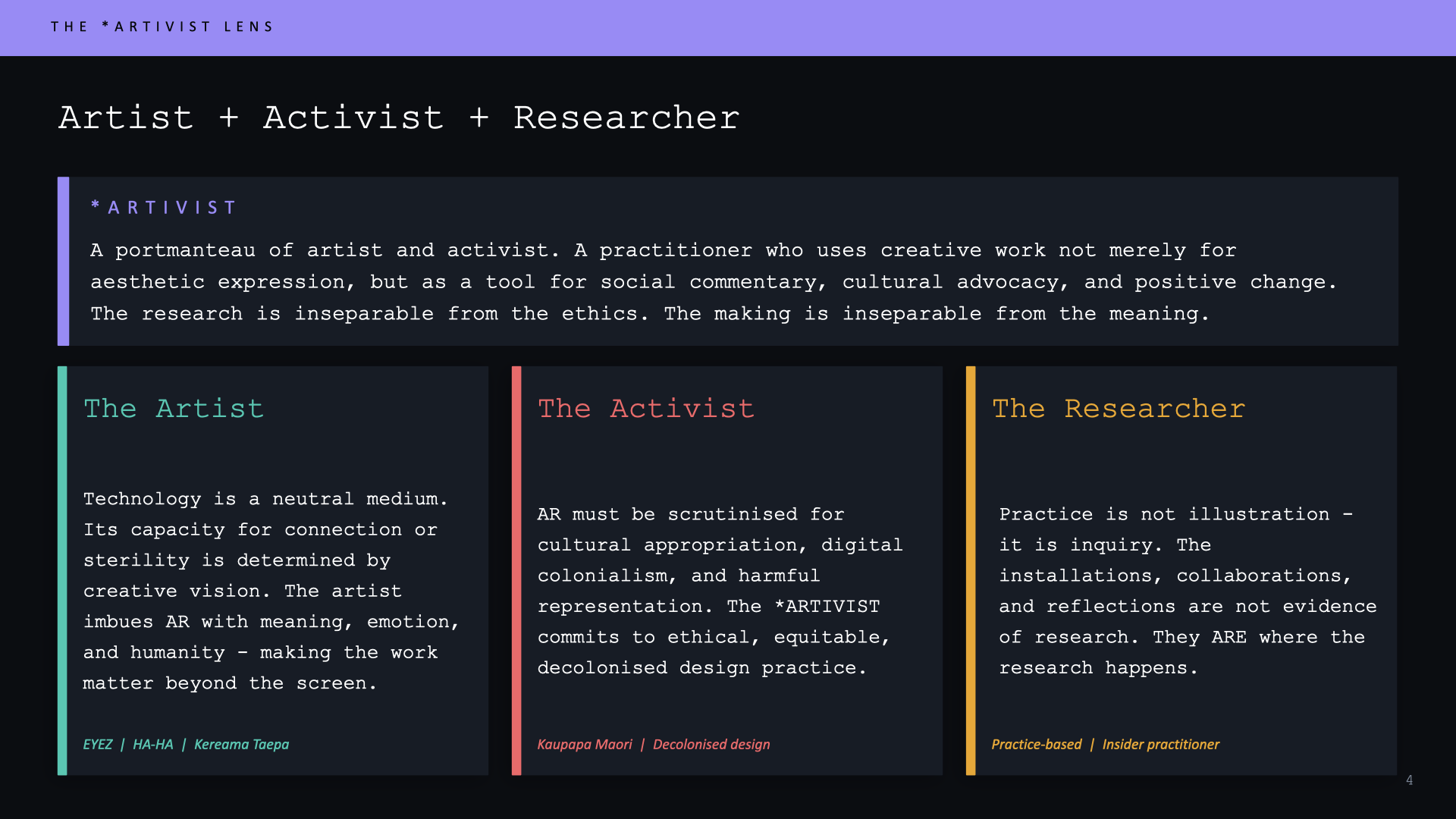
“The lens guiding this work is *ARTIVIST: artist, activist and researcher.
As an artist, I treat technology as a neutral medium. Its meaning depends on creative intention. Artists make AR matter beyond the screen.
As an activist, I argue that AR cannot be separated from ethics. It must be examined for appropriation, digital colonialism and harmful representation. That is why kaupapa Māori and decolonised design are structural, not decorative, in this work.
As a researcher, I treat practice as inquiry. The installations, collaborations and reflections are not supplementary evidence. They are where the research happens.”
Slide 5 — Why practitioners, not the public
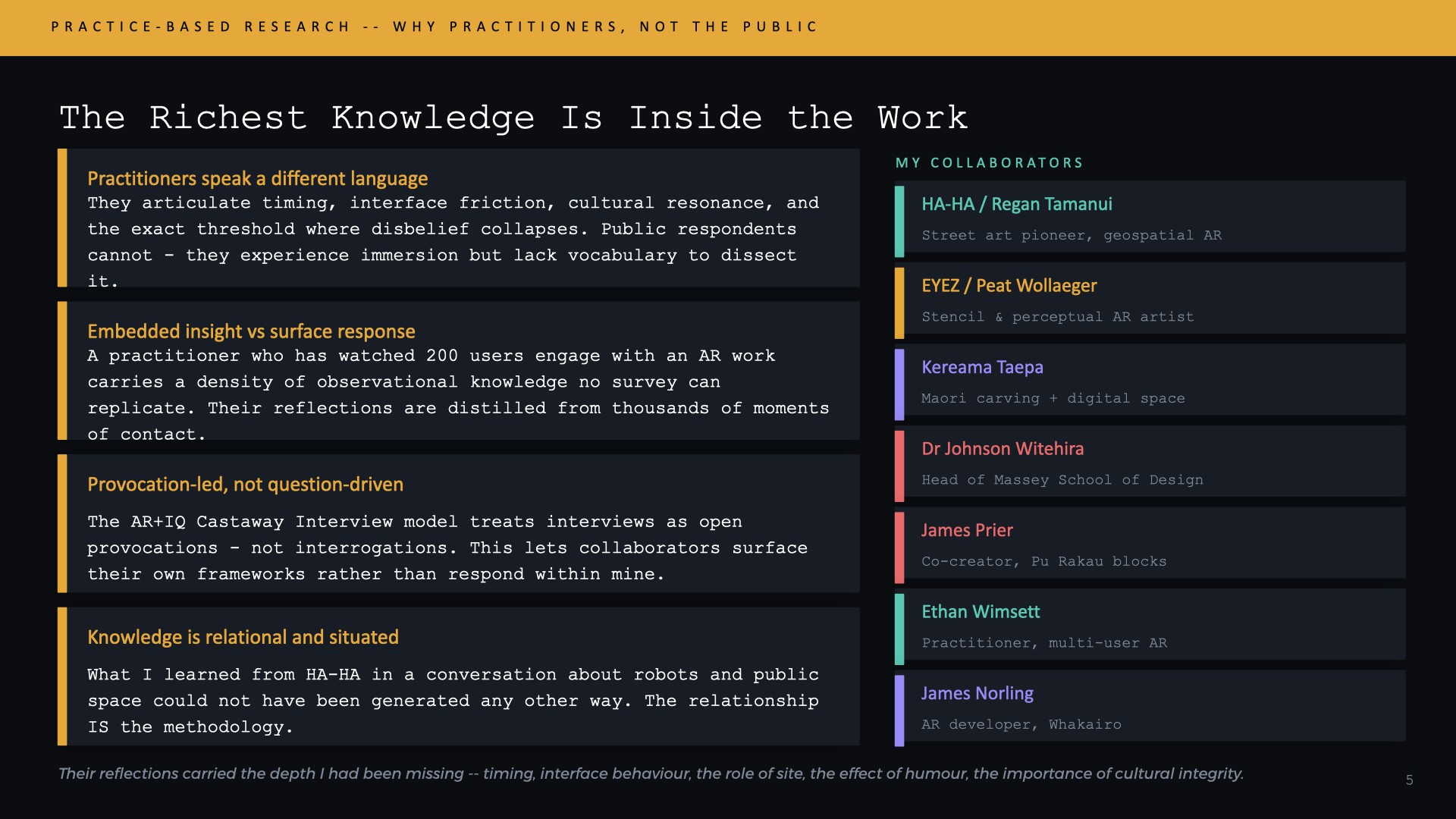
“The richest knowledge turned out to be inside the work. Practitioners speak a different language. They can articulate the precise moment where an AR experience becomes believable, and the exact conditions under which that belief fails.
A practitioner who has watched hundreds of users encounter a work carries a dense observational knowledge that cannot be replicated through a survey alone. This is why the interviews in this project were framed as open provocations rather than tightly controlled questions. The aim was not to force participants into my framework, but to let them surface their own.
That is also why relationship matters here. The methodology is relational and situated.
What emerged from conversations with collaborators could not have been generated in the abstract.”
Slide 6 — Practice-based research sites
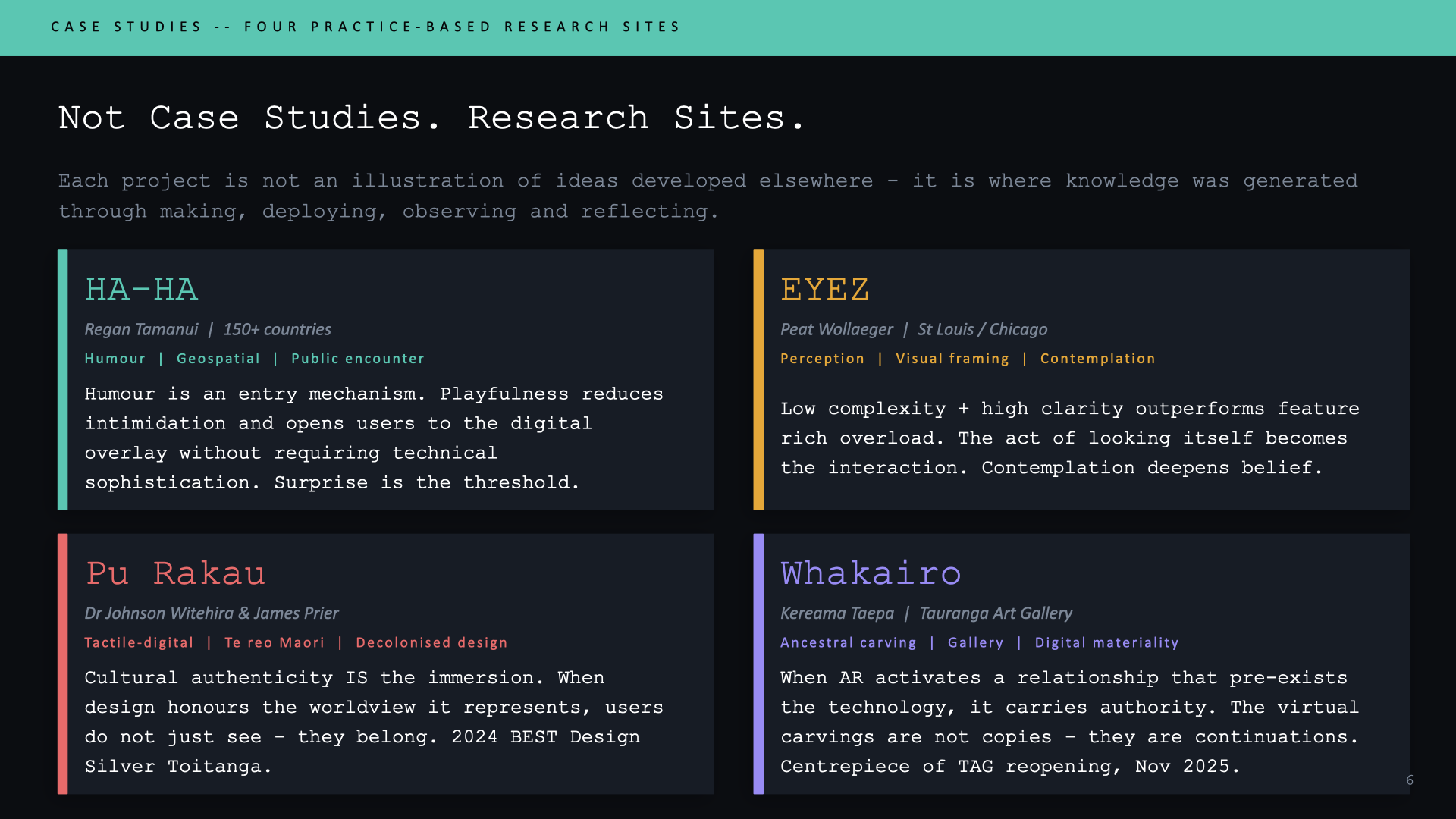
“These four projects are not just case studies. They are research sites.
HA-HA showed that humour and surprise can operate as entry mechanisms into belief.
Play reduces intimidation and opens the user to the digital overlay.
EYEZ showed that low complexity and high clarity often outperform feature-rich interaction. The act of looking becomes the interaction.
Pū Rākau demonstrated that tactile-digital design and cultural authenticity can deepen immersion. In that project, the physical object anchors belief before the digital layer even begins.
Whakairo showed that when AR extends a relationship that already exists culturally and spatially, the work carries authority. The virtual carving is not experienced as a copy, but as a continuation.”
Slide 7 — HA-HA image
“This image represents the HA-HA project. In the paper, HA-HA becomes important because it demonstrates that disbelief can be suspended through humour, disruption and public encounter. The point is not realism in a narrow visual sense. The point is whether the encounter feels alive, surprising and contextually right.
HA-HA helped clarify that AR does not need to be solemn or hyper-technical to become believable. In some cases, humour lowers the threshold of entry and makes the virtual feel socially and spatially legitimate.”
Slide 8 — EYEZ image
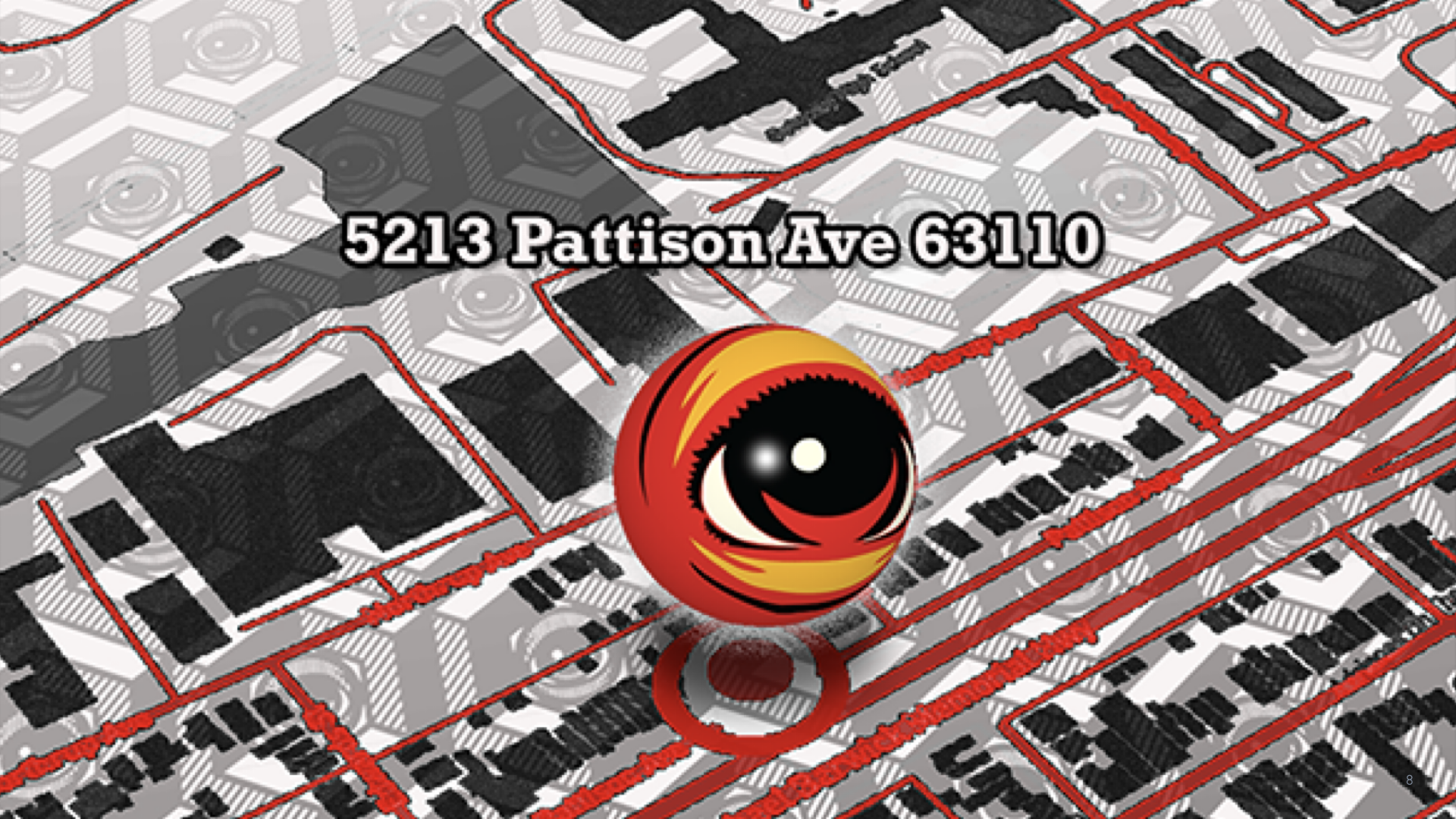
“This slide points to the EYEZ research site. EYEZ sharpened an important finding in the paper: contemplation can be immersive. Belief is not always intensified through more interaction. Sometimes it is strengthened through clarity, stillness and perceptual framing.
This project reinforced the idea that the world itself can become the interface. The less cognitive overhead imposed on the user, the more room there is for immersion to stabilise.”
Slide 9 — Pū Rākau image
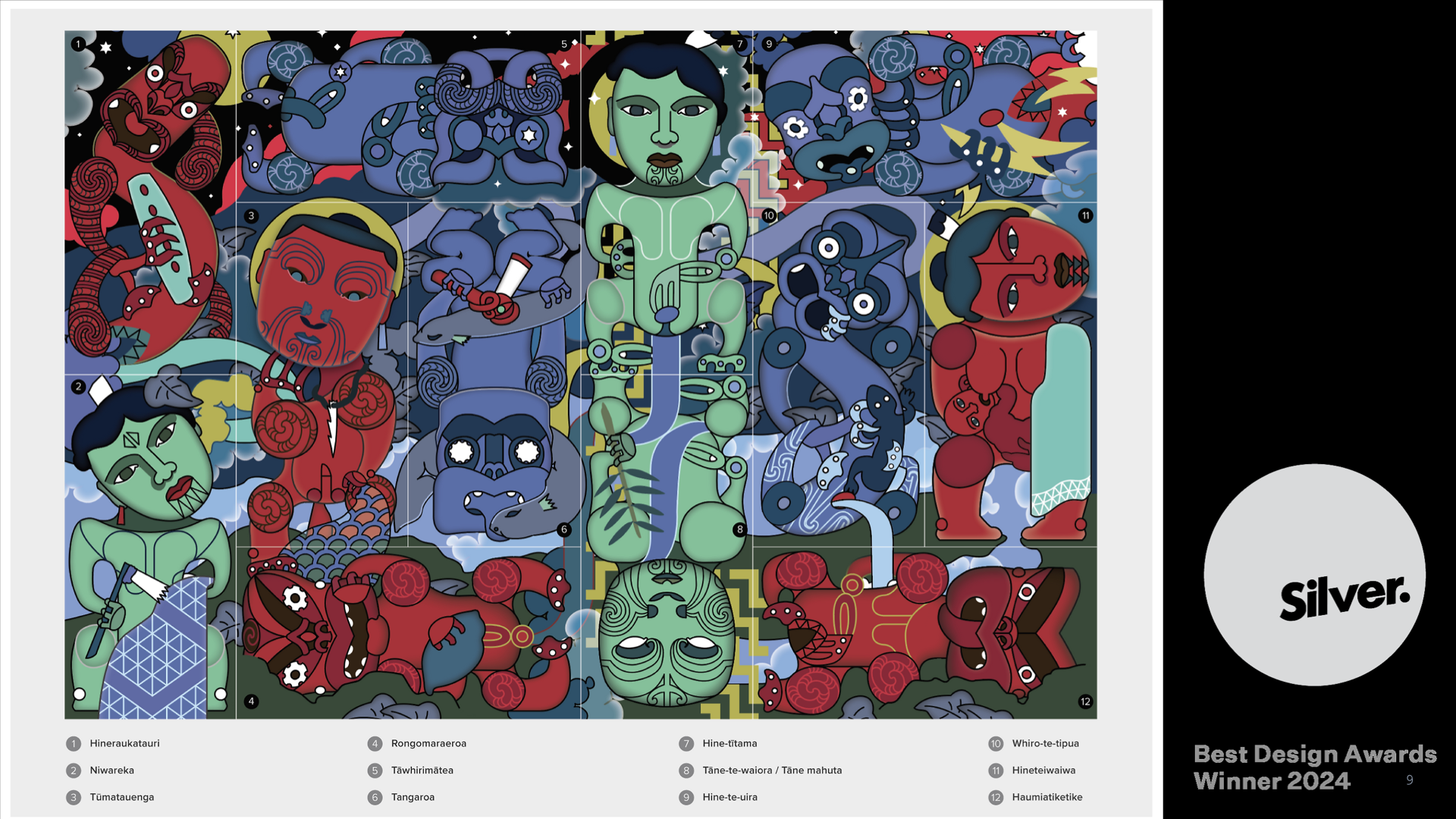
“Pū Rākau was crucial because it joined tactile experience, te reo Māori, mātauranga Māori and AR into a culturally grounded hybrid form. In the paper, this project supports the argument that cultural authenticity is not simply an ethical layer added after design.
It is a structural condition of belief.
The user does not just see digital content. They encounter a coherent world in which physical, narrative and cultural elements align. That alignment produces legitimacy, and legitimacy strengthens immersion.”
Slide 10 — Whakairo image
“Whakairo extended this argument further. In this project, digital carvings respond to movement and occupy a relationship with space, ancestry and material form that pre-exists the device. This is where the paper moves beyond technical explanation and into cultural and phenomenological depth.
The key insight from Whakairo is that digital materiality can carry mana when it is structurally grounded. The more culturally coherent the work, the less the user experiences it as a superficial overlay.”
Slide 11 — Transitional visual / pause
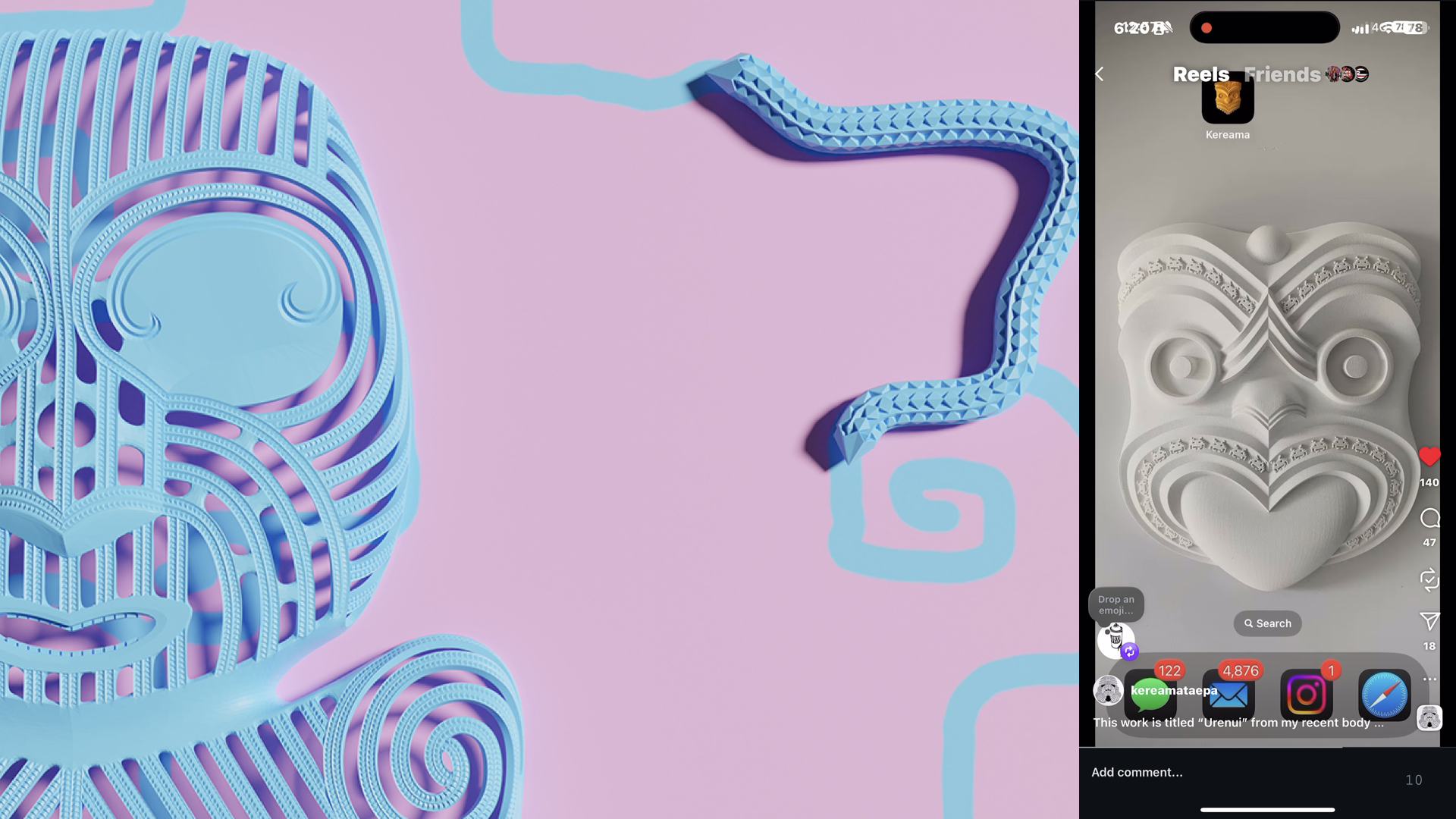
“This slide operates as a visual pause in the presentation, but conceptually it marks the movement from project examples to synthesis.
Up to this point, I have shown how the projects generated knowledge. From here, I move into what that practice revealed across the paper as recurring design conditions for believable AR.”
Slide 12 — Findings: SoD is assembled, not delivered
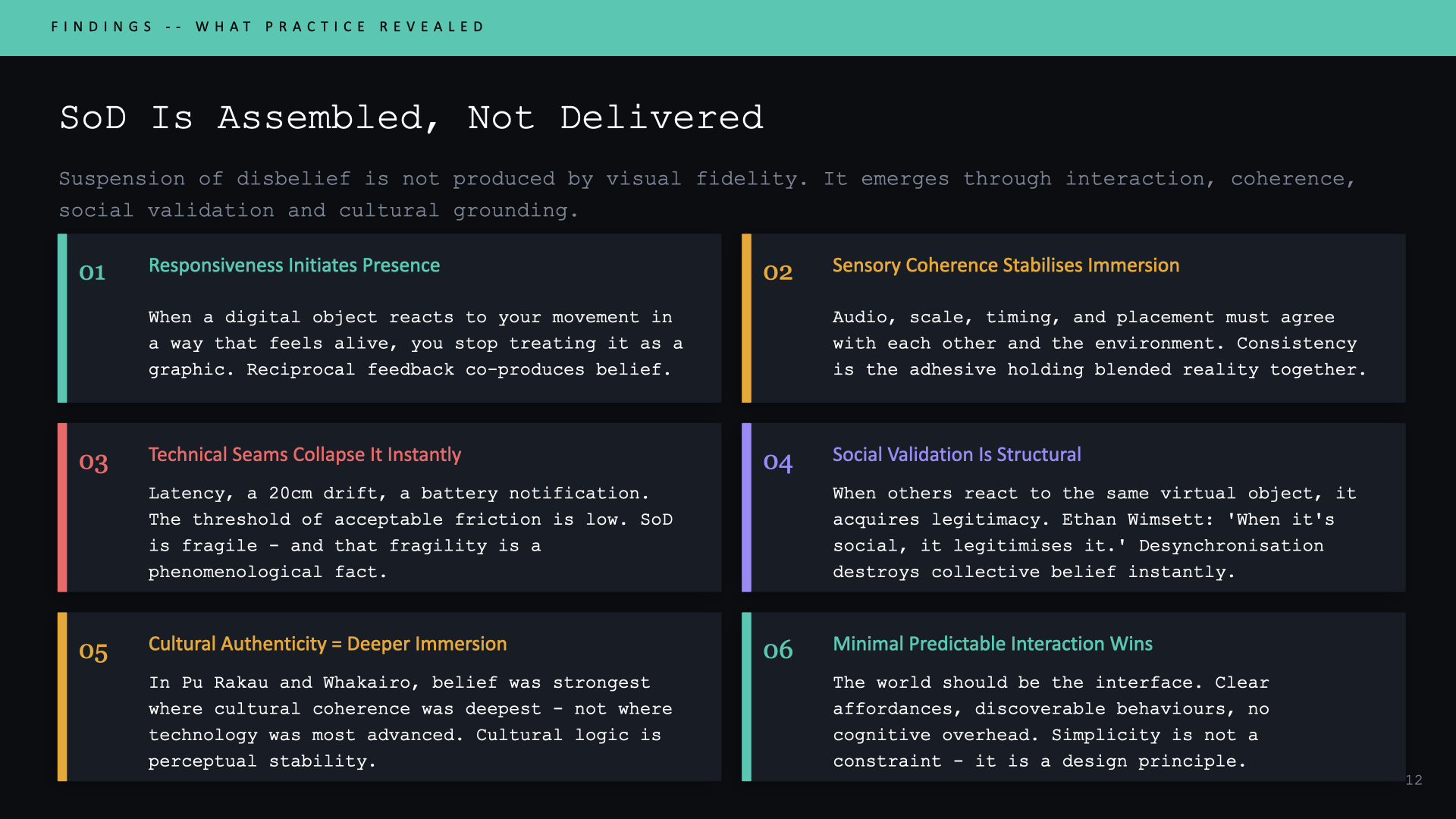
“One of the clearest conclusions of the paper is this: suspension of disbelief is assembled, not delivered.
It does not come from visual fidelity alone. It emerges through interaction, sensory coherence, social validation and cultural grounding.
The findings can be summarised in six points:
first, responsiveness initiates presence;
second, sensory coherence stabilises immersion;
third, technical seams collapse it instantly;
fourth, social validation is structural;
fifth, cultural authenticity deepens immersion;
and sixth, minimal, predictable interaction wins.
In other words, believable AR is not about adding more. It is about making the experience coherent enough that the user stops observing the system and starts inhabiting the experience.”
Slide 13 — Causal Layered Analysis
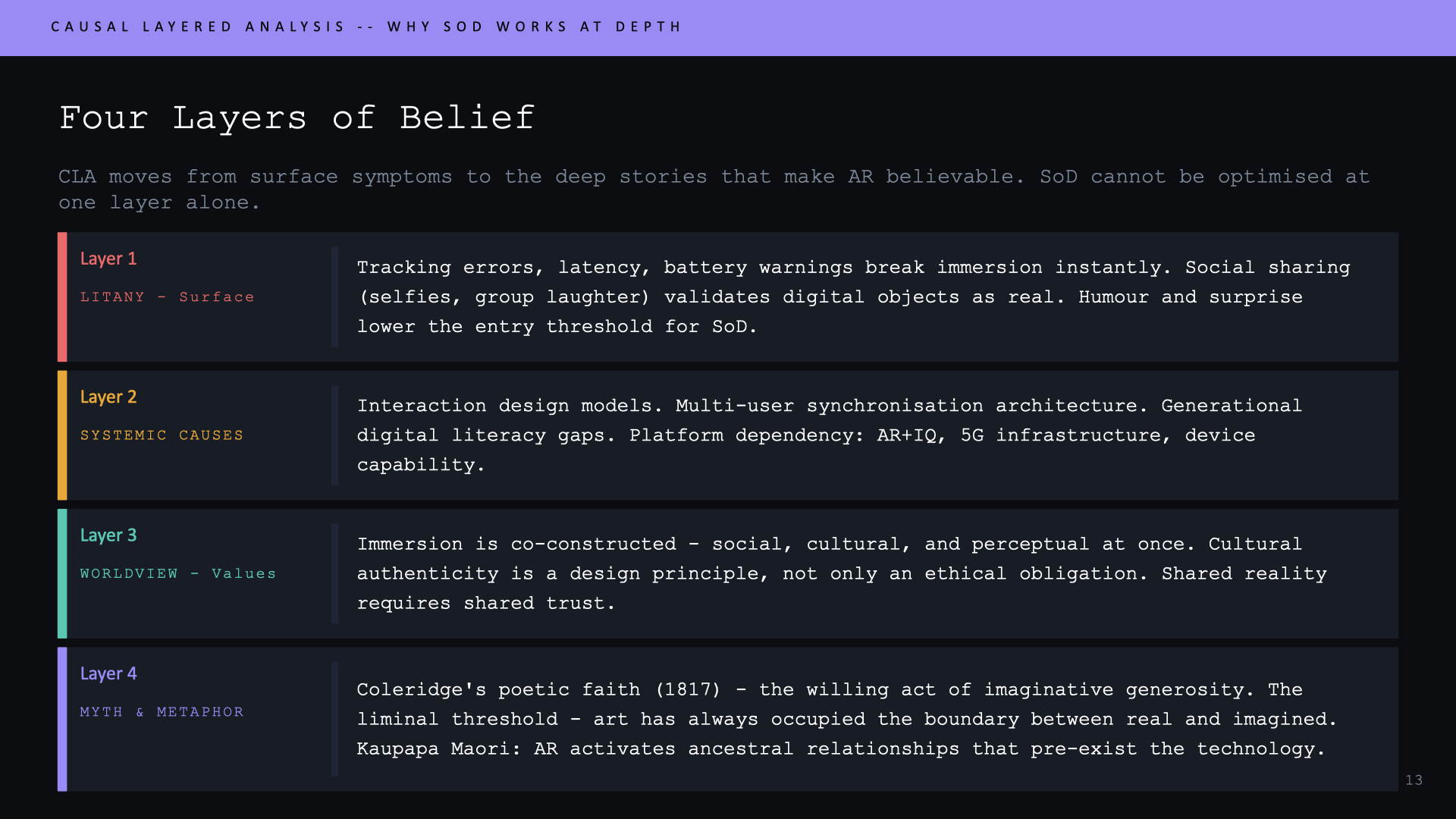
“To understand why these findings matter at depth, I apply Causal Layered Analysis.
At the litany level, we see the surface symptoms: latency, drift, battery warnings, glitches, social laughter, surprise.
At the systemic level, we see the structures underneath: interaction design, synchronisation architecture, platform capability, device conditions.
At the worldview level, we see that immersion is socially and culturally co-constructed.
Shared reality depends on shared trust.
At the deepest level of myth and metaphor, the work returns to Coleridge’s notion of poetic faith and to kaupapa Māori understandings of relationships that pre-exist the technology.
CLA helped me show that SoD cannot be optimised at one layer alone. Belief in AR is technical, social, cultural and symbolic all at once.”
Slide 14 — Practice-derived framework
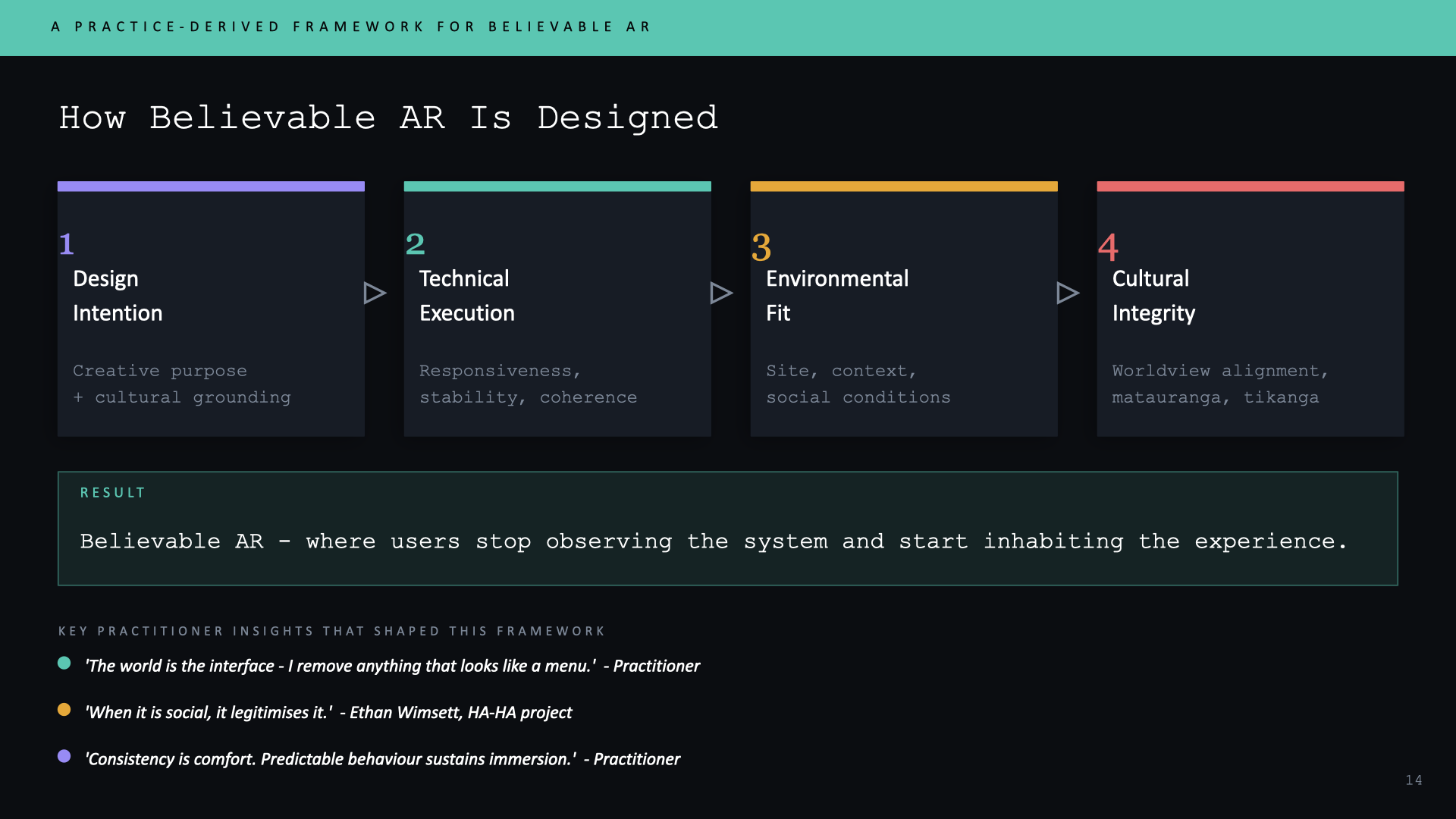
“From the case studies, interviews, reflection and analysis, the paper proposes a practice- derived framework for believable AR.
It has four interdependent parts:
design intention,
technical execution,
environmental fit,
and cultural integrity.
Design intention asks why the experience exists and what values ground it.
Technical execution concerns responsiveness, stability and coherence.
Environmental fit addresses site, context and social conditions.
Cultural integrity asks whether the worldview, tikanga and knowledge systems are genuinely aligned with the work.
When these four elements align, users stop focusing on the mechanism and begin inhabiting the experience.”
Slide 15 — Three things I know now / conclusion
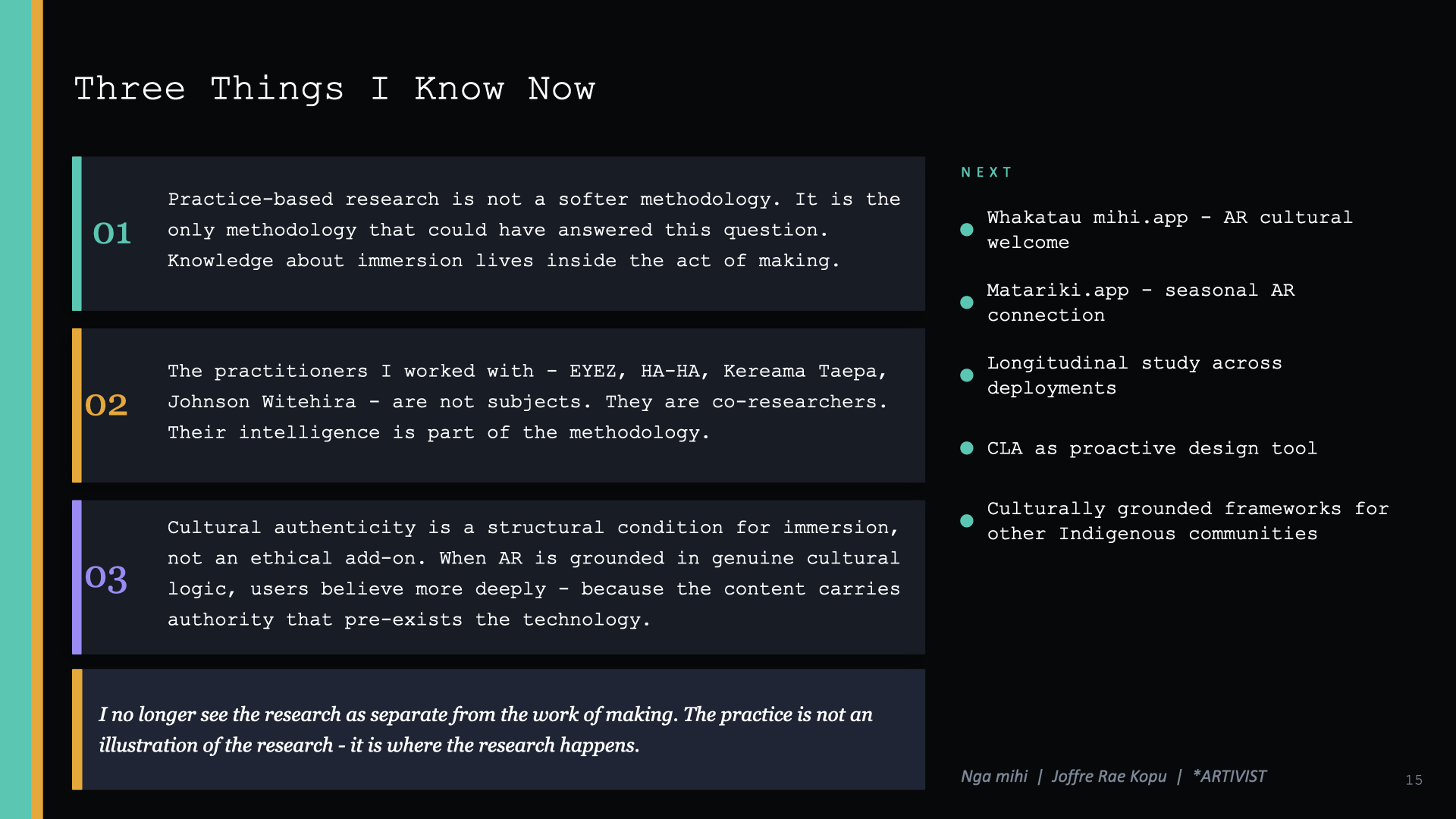
“I close with three things I now know.
First, practice-based research is not a softer methodology. For this question, it was the necessary methodology, because knowledge about immersion lives inside the act of making.
Second, the practitioners I worked with are not simply subjects of the research. They are co-researchers. Their intelligence, observations and frameworks are part of the methodology.
Third, cultural authenticity is a structural condition for immersion, not an ethical extra.
When AR is grounded in genuine cultural logic, users believe more deeply because the work carries authority beyond the device.
The future direction of this research is to continue testing these principles through further culturally grounded AR deployments, longitudinal development, and the use of CLA as a proactive design method.
So the final point is simple: the practice is not an illustration of the research. The practice is where the research happens.”