Art vs design and the $5.3m Creative NZ contract
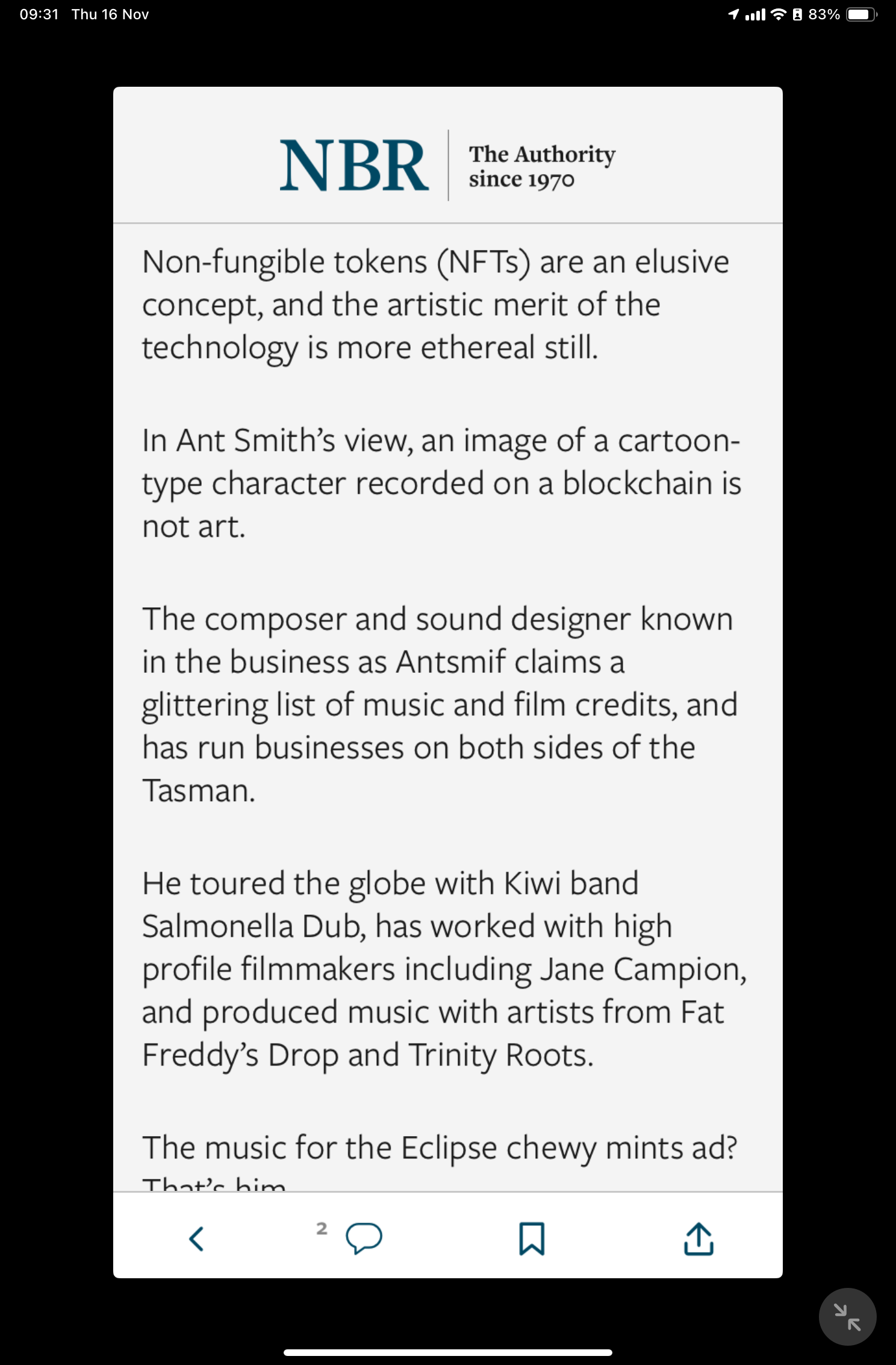
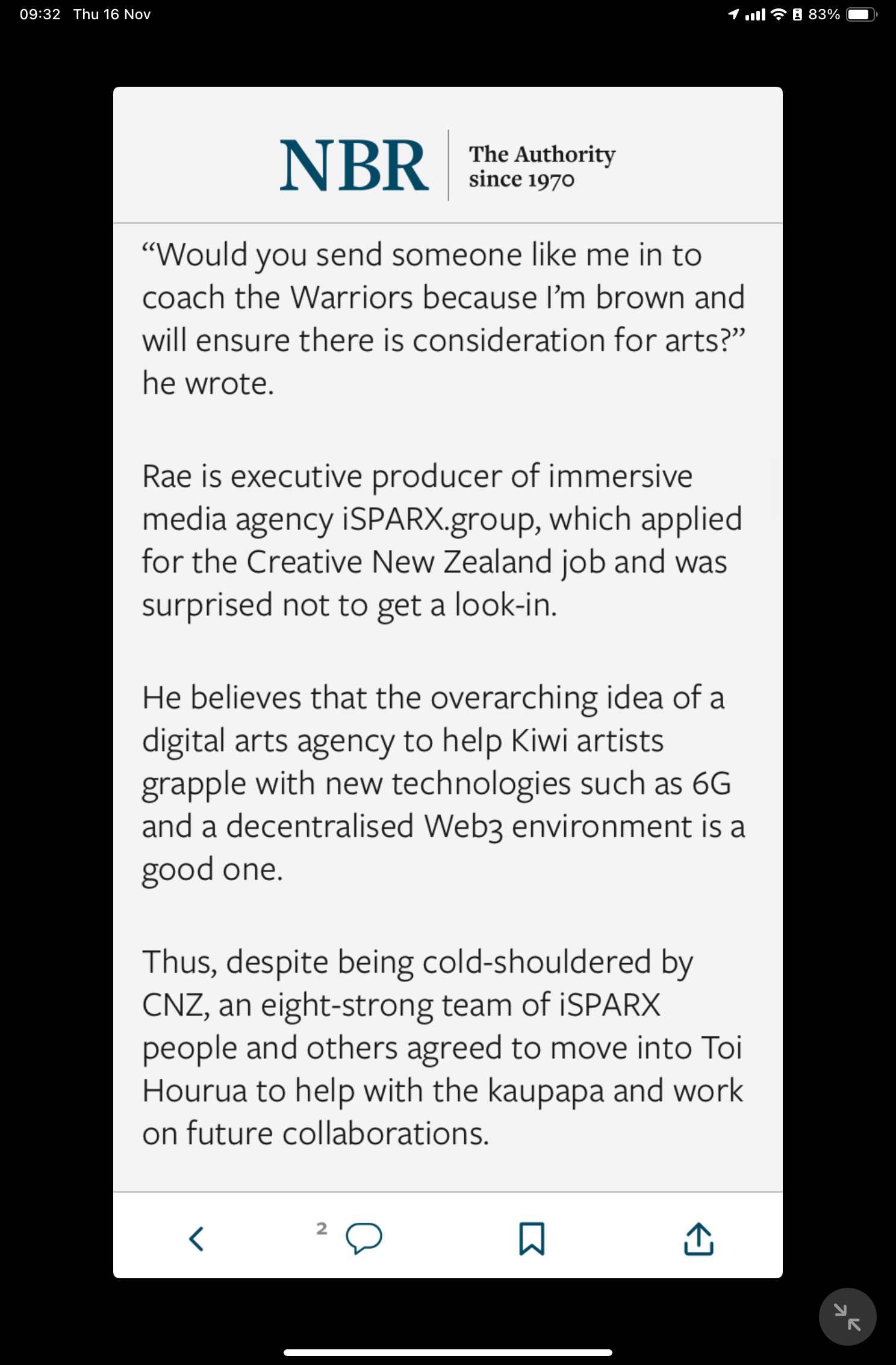
The recipient of a lucrative Covid contract to develop a digital arts agency had no experience and was more focused on NFTs, artists claim.

NBR Article Context
This page responds to the November 2023 NBR article “Art vs design and the $5.3m Creative NZ contract”, which examined the awarding of a $5.3 million Creative New Zealand contract to build a Digital Arts Commissioning and Capability Service for Māori and Pasifika artists.
The article exposed a deeper fault line in Aotearoa’s creative sector: who is trusted to lead digital arts, who gets funded to shape its future, and whether public investment is being directed with sufficient credibility, cultural understanding, and practical knowledge of the field.
This was never a minor disagreement. It was a live test of whether digital arts in Aotearoa would be supported by people with genuine sector experience, or by structures that could speak the language of innovation without being accountable to the realities of artistic practice.
What the article brought into focus
The NBR piece raised serious questions about whether the organisation entrusted with this work had the right grounding in digital arts commissioning, artist development, and sector leadership.
At the centre of the criticism was a concern that a publicly funded initiative intended to support artists was drifting into territory that felt misaligned with the actual needs of the community it was meant to serve. The issue was not simply technological language or new business models. It was the blurring of art, design, branding, speculative digital trends, and capability building into a single narrative that did not stand up to close scrutiny.
For many practitioners, that was the real problem.
Digital arts is not a vague category. It is a serious field of practice. It includes moving image, sound, immersive installation, interactive systems, spatial media, game engines, digital performance, AI-assisted creation, and emerging forms that sit across art, culture, and technology. It requires commissioning literacy, production knowledge, and an understanding of how artists actually make work.
Without that, the language of innovation becomes a substitute for capability.


Ants Smith and Joff Rae
The article specifically referenced practitioners Ants Smith and Joff Rae, both of whom had direct experience inside the environment being promoted as part of this initiative.
Their presence mattered because they were not distant commentators. They were people with practical knowledge of digital production, creative technology, sound, immersive media, and interdisciplinary art-making. Their concerns were grounded in observation and lived involvement, not speculation.
As reflected in the reporting, both Ants Smith and Joff Rae became concerned that the direction of the initiative did not match the level of responsibility attached to the funding. The gap between the stated public purpose and the operational reality was too large to ignore. Their criticism gave public shape to a concern others in the sector were already feeling privately: that the work was being framed as a digital arts service without demonstrating the depth, structure, or leadership required to justify that claim.
Their inclusion in the article remains important because it showed that the critique was coming from experienced practitioners prepared to put their names against a difficult public issue.
The real issue
The deeper issue was never whether digital arts should engage with new tools, new economies, or new platforms. Of course it should.
The issue was whether artists were being properly served by a model that appeared to confuse visibility with substance.
A credible digital arts capability service should be able to do the following:
understand the difference between artistic development and commercial content production
commission work with curatorial and cultural intelligence
support Māori and Pasifika artists in ways that are actually useful
provide pathways, mentorship, and production knowledge
build trust through competence rather than marketing
distinguish between experimentation and distraction
That is not an unreasonable standard. It is the minimum standard.
When public money is allocated in the name of artists, the burden of proof sits with those receiving the funding. They should be able to show not only ambition, but fitness for purpose.
Why this still matters
This article still matters because the questions it raised have not gone away.
Who gets to define digital arts in Aotearoa?
Who gets funded to build its infrastructure?
Who is allowed to speak for artists?
And what happens when artists themselves do not recognise their own needs in the system built around them?
These are not abstract questions. They affect careers, opportunities, access, confidence, and the long-term shape of the sector.
If public agencies want trust, they need to back models that are artist-informed, culturally grounded, and demonstrably capable. Not just well-packaged. Not just well-connected. Capable.
Our view
Digital arts deserves serious leadership.
It deserves leaders who understand artists, production, commissioning, tikanga, experimentation, and delivery. It deserves structures that are built from practice, not from trend language. It deserves public investment that can withstand scrutiny from the very people it claims to support.
The point raised by Ants Smith, Joff Rae, and others was not anti-technology and it was not anti-future. It was, and remains, a demand for integrity.
If Aotearoa wants a credible digital arts future, it cannot be built on vague positioning, blurred categories, or symbolic proximity to innovation. It must be built on experience, accountability, and trust.
That is the standard.
That was the issue.
And that is why this article still matters.