
Why AR+IQ exists.
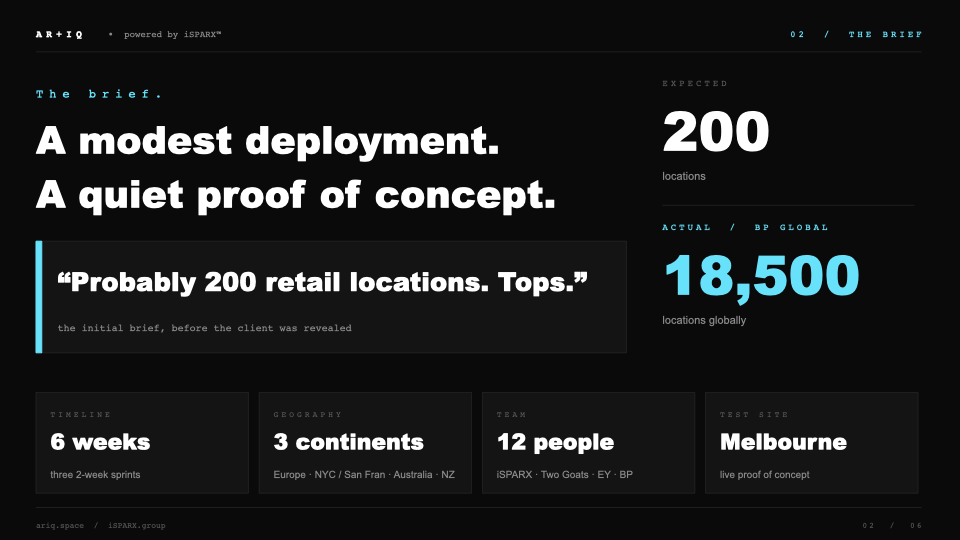
“EY came to iSPARX™ with what sounded like a small retail activation brief.
The ask was simple: create an AR engagement experience for retail.
The expectation? ‘Probably 200 locations, tops.’
But once we got inside the project, we realised this wasn’t a standard campaign at all.
It was a proof-of-concept for potential deployment across BP’s global network of 18,500 locations.
And suddenly the challenge changed completely.
This wasn’t about building one app.
It was about solving scale, deployment, interoperability, and customer engagement across a massive physical network.
We had six weeks.
Three two-week sprints.
International coordination across three continents.
Multiple flights between Australia, New Zealand, and global stakeholders.
A delivery team of twelve people: six from iSPARX™, alongside partners from Two Goats, EY, and BP itself.
And we still had to deliver a working, tested AR application live on-site in Melbourne.
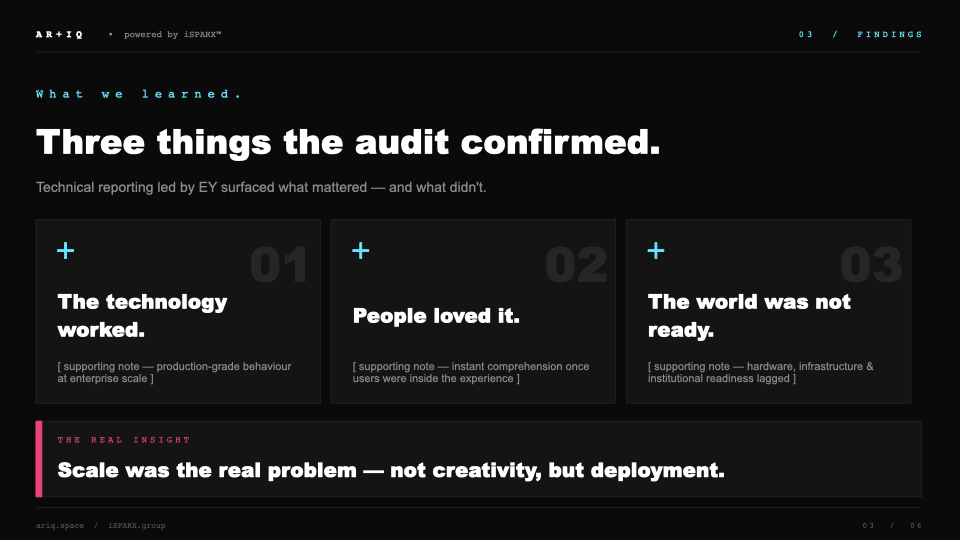
What we discovered during that process was bigger than the project itself.
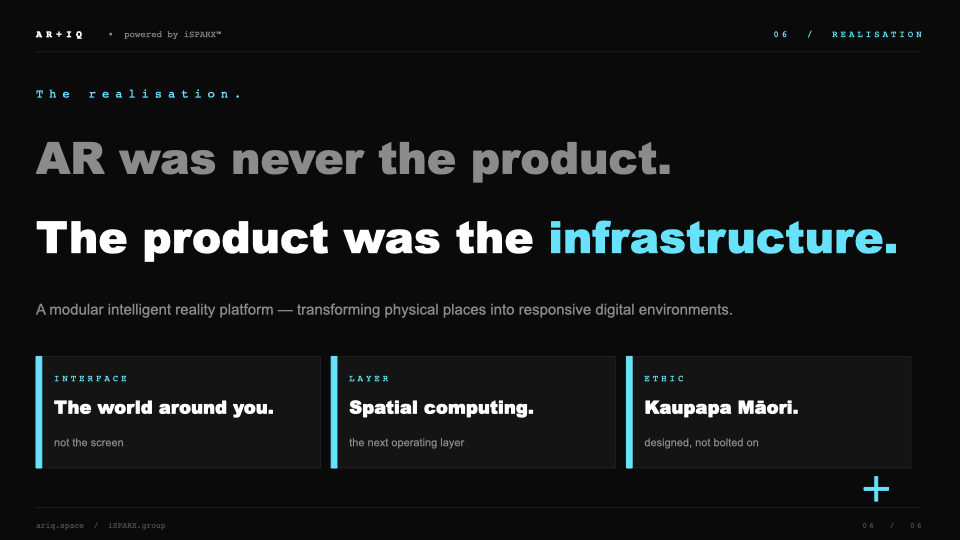
The real problem wasn’t creativity.
Brands already understood the value of immersive experiences.
The real constraint was infrastructure.
Enterprise AR was fragmented, expensive, slow to deploy, and impossible to scale efficiently across large physical environments.
Every deployment became a bespoke rebuild.
Every location introduced new complexity.
That meant most companies stayed trapped in endless pilots instead of operational rollout.
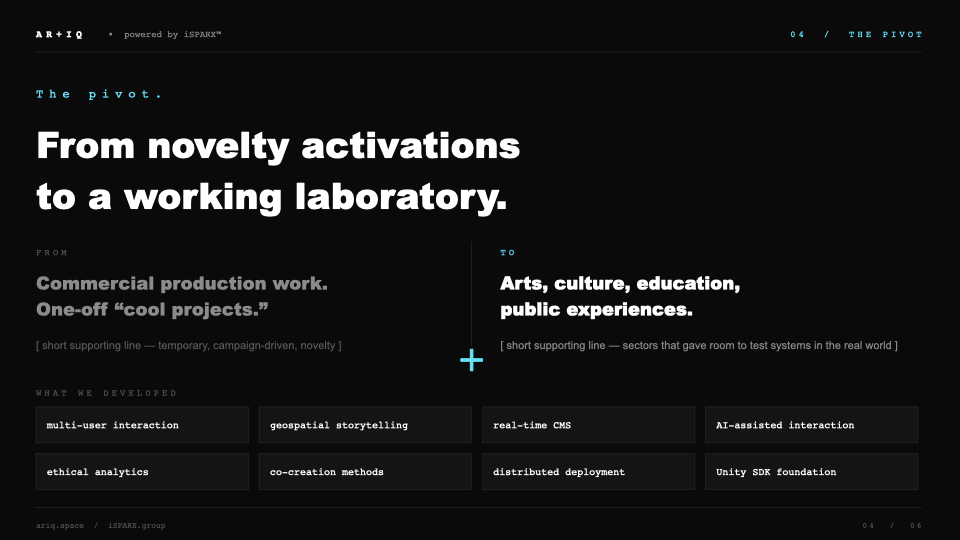
So we stepped back and reframed the problem.
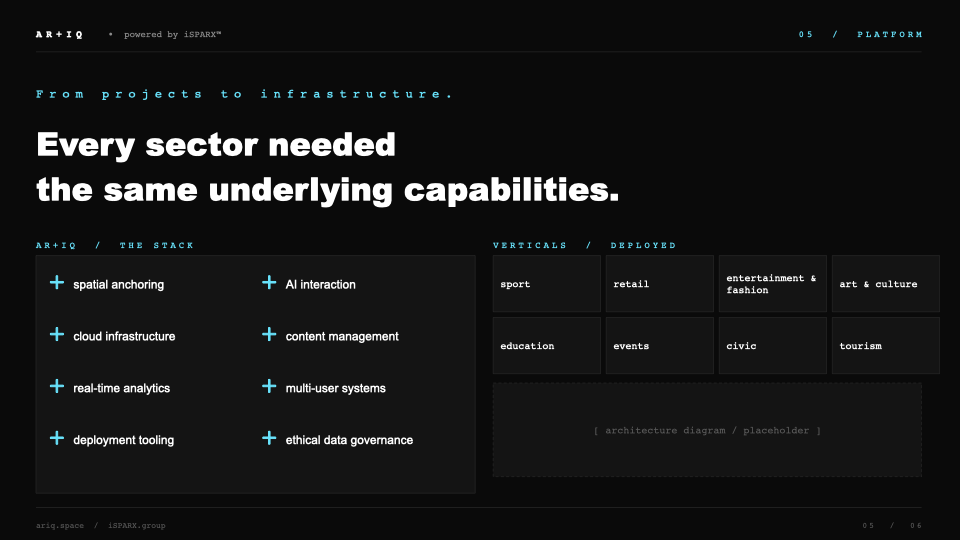
Instead of building another one-off AR app, we began building a modular intelligent reality platform.
That became AR+IQ.
A scalable spatial computing framework combining AR, AI, geospatial systems, analytics, and cloud infrastructure into a reusable deployment layer.
What started as a retail proof-of-concept became the foundation for something much larger:
A system designed to turn physical spaces into intelligent, responsive environments.
Retail was just the beginning.
Today, AR+IQ extends into culture, tourism, education, events, and public infrastructure.
The lesson from BP was clear:
The future wasn’t about apps on screens.
It was about infrastructure for the real world.”