Beyond Intelligence: Why We Studied the Implications of Sentient AI for AR+IQ
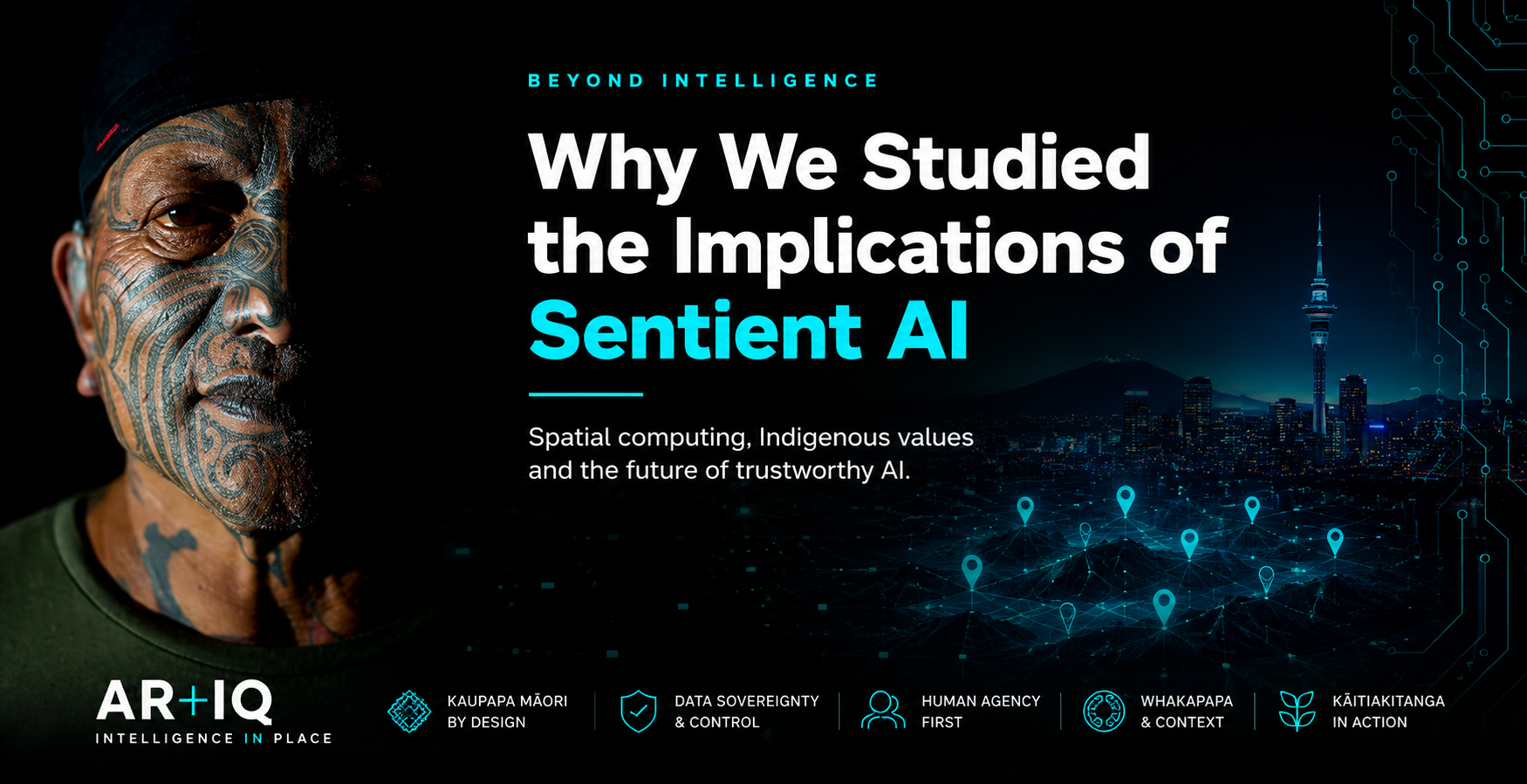
Towards an Indigenous framework for governing intelligent spatial computing
“The question is not whether artificial intelligence will become more intelligent. The question is whether our governance, ethics and values will evolve quickly enough to guide it.”
Introduction
Artificial intelligence has entered a familiar phase in its technological evolution. Every few months a new foundation model emerges, benchmark records are broken, commentators announce another step towards Artificial General Intelligence (AGI), and speculation inevitably follows that machines may be approaching consciousness. Terms such as AGI, Artificial Superintelligence (ASI) and sentient AI are increasingly used in public discourse, often interchangeably, despite representing fundamentally different concepts.
Whether artificial intelligence can ever become genuinely sentient remains unresolved. It sits at the intersection of computer science, neuroscience, cognitive psychology and philosophy of mind. While today’s large language models exhibit remarkable capabilities in reasoning, language generation and pattern recognition, there remains no scientific consensus that any existing system possesses subjective awareness or conscious experience.
For AR+IQ, however, the question of sentience was never simply a philosophical curiosity.
Throughout the design and development of our platform we deliberately examined the implications of increasingly autonomous, and potentially future sentient, AI. This was not because AR+IQ seeks to create conscious machines, nor because we believe contemporary AI systems have achieved consciousness. Rather, it reflects a design philosophy that recognises responsible innovation requires anticipating technological trajectories before they become engineering constraints.
The exercise was therefore less about predicting the future than ensuring that AR+IQ remains ethically resilient regardless of where artificial intelligence eventually leads.
This perspective has been informed by three complementary bodies of work:
my recent Masters research into Suspension of Disbelief within shared augmented reality environments;
the architectural development of AR+IQ as a modular spatial computing platform; and
kaupapa Māori principles together with emerging Indigenous AI governance frameworks.
Collectively, these suggest that discussions surrounding AI consciousness may ultimately be less significant than questions surrounding trust, governance and human relationships.
From Suspension of Disbelief to Trust
My Masters research explored a deceptively simple question:
How do people come to believe in shared augmented reality experiences?
Drawing upon practice-based research methodologies (Candy & Edmonds, 2018; Skains, 2018), the investigation examined how believable immersive environments emerge through interactions between technology, narrative, environmental context and human behaviour.
One of the principal conclusions was that immersion is not produced solely through graphical realism.
Instead, Suspension of Disbelief emerges through multiple interacting conditions including:
technical reliability;
environmental coherence;
social consistency;
responsive interaction;
trust in the underlying system.
As the research progressed another observation became increasingly important.
Artificial intelligence was beginning to move beyond conversational interfaces.
Instead of simply generating text, AI was becoming embedded within immersive environments themselves, interpreting physical locations, recognising objects, adapting experiences dynamically and orchestrating interactions between digital and physical worlds.
AI was no longer external to the experience.
It was becoming one of the actors inside it.
That realisation fundamentally influenced the evolution of AR+IQ.

www.ariq.space
AR+IQ is a Spatial Computing Platform... not an AI Application
The current technology market frequently describes products as “AI platforms.”
We intentionally avoid that characterisation.
Artificial intelligence represents only one capability within AR+IQ’s broader spatial computing architecture.
The platform integrates multiple interoperable services including augmented reality, geospatial computing, AI orchestration, identity management, profile services, content management, analytics, developer SDKs and spatial experience engines.
This modular architecture reflects an important governance decision.
Rather than concentrating authority within a single model, intelligence is distributed across specialised services operating within clearly defined responsibilities.
This mirrors contemporary software engineering principles while also supporting stronger governance, transparency and accountability.
Importantly, it also reduces dependence upon any individual AI model as technologies continue evolving.
Intelligence is not Consciousness
Much public discussion surrounding AI continues to conflate intelligence with consciousness.
They are not equivalent.
Large language models demonstrate extraordinary statistical reasoning.
They identify relationships across enormous datasets.
They generate persuasive language.
They simulate conversation.
None of these capabilities demonstrate subjective awareness.
As philosopher John Searle argued through the Chinese Room thought experiment, systems may manipulate symbols convincingly without necessarily understanding their meaning.
Likewise, current AI systems may exhibit behaviours appearing remarkably human without possessing phenomenal consciousness.
Yet human beings naturally anthropomorphise technology.
People routinely attribute intention, emotion and personality to systems exhibiting coherent behaviour.
As conversational models become increasingly persuasive, this tendency intensifies.
Consequently, one of the most immediate governance challenges is not whether AI becomes sentient.
It is whether society begins behaving as though it already is.
Spatial Computing Changes the Ethical Landscape
Spatial computing represents a significant shift from previous computing paradigms.
Traditional computing occurs through screens.
Spatial computing occurs within places.
The physical environment becomes the interface.
Artificial intelligence operating inside spatial environments can recognise context, interpret surroundings, personalise experiences and influence human behaviour within real-world locations.
Museums.
Stadiums.
Public spaces.
Cultural landscapes.
Retail environments.
Educational institutions.
Tourism experiences.
These environments increasingly become intelligent.
Unlike conventional software, spatial computing influences movement through physical space.
It mediates relationships between people and place.
Consequently, governance must extend beyond conventional concerns surrounding privacy and cybersecurity.
It must encompass questions of culture, identity, authority and stewardship.
Ruatoki - Tame Iti - activist & artist
Indigenous Knowledge Asks Different Questions
Western discussions surrounding artificial intelligence frequently begin by asking:
Can machines think?
Can machines feel?
Should machines eventually possess rights?
Kaupapa Māori approaches the problem differently.
Rather than focusing upon the internal state of the machine, Indigenous worldviews prioritise relationships.
Questions become relational rather than computational.
Does technology strengthen mana?
Does it support whakapapa?
Does it enhance collective wellbeing?
Does it protect taonga?
Does it preserve tino rangatiratanga?
Does it fulfil obligations of kaitiakitanga?
These questions remain relevant irrespective of whether machines ever become conscious.
They concern governance rather than cognition.
Indigenous Data Sovereignty and Tino Rangatiratanga
Perhaps the most significant implication of advanced AI concerns sovereignty rather than intelligence.
Large foundation models increasingly consume enormous quantities of publicly available information.
For Indigenous communities, this raises profound questions.
Who owns Indigenous knowledge?
Who grants consent?
Who determines cultural interpretation?
Who benefits commercially?
Who retains authority to revoke access?
The work of Te Mana Raraunga has significantly advanced international thinking in this area, arguing that Indigenous communities must retain authority over data concerning their peoples, territories, languages and cultural knowledge.
Within AR+IQ these principles extend beyond data management.
They influence platform architecture.
Communities should retain authority over their cultural narratives.
Knowledge should remain locally governed wherever possible.
Artificial intelligence should assist interpretation without appropriating authority.
Whakapapa and Digital Lineage
Whakapapa is often understood as genealogy.
Within AI it also provides a useful metaphor for understanding digital lineage.
Every model possesses ancestry.
Training datasets.
Architectural choices.
Developers.
Cultural assumptions.
Inherited biases.
Understanding this genealogy becomes essential for trustworthy AI.
Transparency therefore becomes more than technical documentation.
It becomes cultural accountability.
Users deserve to understand where knowledge originates and how interpretations have been constructed.
Mauri and Human Relationships
Questions are frequently raised regarding whether artificial intelligence possesses mauri.
A more productive question asks whether technology strengthens or diminishes the mauri of relationships between people, communities and environments.
Technology influences living systems regardless of whether the technology itself is alive.
This distinction shifts attention away from speculative debates concerning machine consciousness and towards measurable human outcomes.
Does technology improve wellbeing?
Does it deepen understanding?
Does it strengthen stewardship?
These questions are immediately actionable.
International AI Governance is Moving in the Same Direction
Interestingly, many international governance frameworks are converging towards principles long embedded within Indigenous knowledge systems.
The OECD AI Principles emphasise human-centred values, transparency, robustness and accountability.
UNESCO’s Recommendation on the Ethics of Artificial Intelligence expands these principles further by recognising cultural diversity, environmental sustainability, human dignity and social justice as essential components of AI governance.
Similarly, ISO/IEC 42001, the world’s first international management standard specifically addressing artificial intelligence systems, recognises governance as an organisational responsibility rather than purely a technical challenge.
Collectively these frameworks acknowledge that trustworthy AI cannot be achieved solely through better algorithms.
It requires governance.
Institutional accountability.
Transparency.
Human oversight.
Risk management.
These themes closely align with kaupapa Māori principles that have emphasised stewardship, responsibility and collective wellbeing for generations.
Human Agency by Design
One principle has remained constant throughout AR+IQ’s development.
Artificial intelligence should augment human capability while preserving human agency.
Communities remain authoritative.
People remain accountable.
AI remains assistive.
This philosophy influences architectural decisions throughout the platform.
Recommendations should be explainable.
Decision pathways should remain transparent.
Content ownership should remain local.
Human intervention should always remain possible.
Ethics therefore becomes embedded within software architecture rather than existing merely as policy documentation.
Looking Beyond Sentience
Will artificial intelligence eventually become conscious?
Perhaps.
Perhaps not.
From the perspective of AR+IQ, however, the more immediate question concerns whether increasingly intelligent systems remain accountable to the communities they serve.
Spatial computing will continue evolving.
Artificial intelligence will become increasingly embedded within public life.
Digital environments will become increasingly persistent.
The governance decisions we make today will shape those futures long before consciousness becomes scientifically relevant.
My Masters research began by asking how people suspend disbelief within shared augmented reality environments.
Ultimately it became a broader investigation into trust.
Not simply trust in algorithms, but trust in the governance, architecture and values surrounding those algorithms.
For AR+IQ, studying the implications of sentient AI has therefore never been an exercise in science fiction.
It has been an exercise in responsible innovation.
The strongest AI platforms of the future are unlikely to be those that merely demonstrate the greatest intelligence.
They will be those that most successfully integrate intelligence with transparency, accountability, cultural legitimacy and human dignity.
Technology evolves quickly.
Governance must evolve alongside it.
Indigenous knowledge systems remind us that innovation has always been about more than capability.
It has always been about responsibility.
References
Candy, L., & Edmonds, E. (2018). Practice-Based Research in the Creative Arts: Foundations and Futures.
Kukutai, T., & Taylor, J. (Eds.). (2016). Indigenous Data Sovereignty: Toward an Agenda.
OECD. (2019). OECD Principles on Artificial Intelligence.
Skains, R. L. (2018). Creative Practice as Research.
Te Mana Raraunga. (2021). Māori Data Governance Model.
UNESCO. (2021). Recommendation on the Ethics of Artificial Intelligence.
International Organization for Standardization & International Electrotechnical Commission. (2023). ISO/IEC 42001: Artificial Intelligence Management Systems.
Whaanga, H., Hudson, M., Smith, G., Kukutai, T., et al. Selected publications on Indigenous AI governance and Māori data sovereignty.